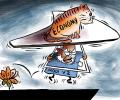
The country's new economic roadmap highlights the importance of creating a virtuous cycle of investment, savings and exports in order to sustain rapid economic growth over the next five years.

India has much to be proud of and celebrate. But there is also much that is wrong, much that looks dangerous. Employment, current account deficit, rural distress, agricultural productivity are all in deep crisis, points out Shekhar Gupta.

A raft of banks could face tough questions in the sweeping US crackdown on alleged corruption in global soccer as prosecutors review how much they knew about millions of dollars in bribes flowing through the US banking system to accounts around the world.

Afwaah is a sum of Sudhir Mishra's thought-provoking reflections and appeal to question what's real, what's rumour, notes Sukanya Verma.

'At a time when there's a lot of conversation happening around how AI has made art directors and production designers jobless, we will simply say that if your work speaks for you, you will never be out of work.'

Shapoorji Pallonji Group's head Pallonji Mistry died at his residence here, company officials said on Tuesday. Mistry, the largest individual shareholder in the Tata Group with a 18.4 per cent holding in the conglomerate, was 93.

Axis Bank Managing Director & Chief Executive Officer Shikha Sharma on the new mechanism for non-performing loans, the bank's loan portfolio, industry outlook and the bank's future plans.

'We suggest investors with suitable risk appetite to consider allocating 40-50 per cent in large-caps, 25-30 per cent of funds in quality mid and small-caps and the rest in debt and high yield products.'

Gujarat and Karnataka have been ranked as the best performers in developing startup ecosystem for budding entrepreneurs, according to the ranking of states and Union territories by the Department for Promotion of Industry and Internal Trade (DPIIT). Among smaller states having population of less than one crore, Meghalaya has been adjudged as the best performer. The rankings are based on the initiatives taken to develop the startup ecosystem for promoting budding entrepreneurs.

The plan is to offer the ratings of drivers to insurers, which can then customise their premiums -- a higher score meaning a lower premium, for instance, and vice-versa.

The US Federal Reserve on Wednesday (local time) raised interest rates by 75 basis points (bps) or three-quarters of a percentage point in the boldest move since 1994.
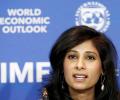
The IMF on Tuesday cut India's economic growth forecast by 0.5 percentage points to 9 per cent for the current fiscal year, with its chief economist Gita Gopinath saying that the slight downgrade is mainly due to the impact of the spread of the Omicron variant. "If you look at the 2021-22 fiscal year, we have a slight downgrade of -0.5 percentage points and for the next fiscal year 2022-23 we have a slight upgrade of 0.5 percentage points. So, growth for the previous fiscal year is now nine per cent and for this year now is at nine per cent. We moved it up slightly," Gopinath told reporters during a news conference in Washington. In its latest update of World Economic Outlook on Tuesday, the International Monetary Fund has cut India's economic growth forecast to 9 per cent for the current fiscal year ending March 31, joining a host of agencies which have downgraded their projections on concerns over the impact of the spread of Omicron on business activity and mobility.

The Railways plans to float an independent fund.

The government on Tuesday said it will allow setting up of world-class foreign universities in Gandhinagar's GIFT City, free from domestic regulations, to facilitate availability of skilled manpower in the financial services space. In addition, an international arbitration centre will be set up in the GIFT City for timely settlement of disputes under international jurisprudence, Finance Minister Nirmala Sitharaman said while presenting the Union Budget for 2022-23. The centre could be on the lines of the Singapore International Arbitration Centre, or the London Commercial Arbitration Centre.

India has the third highest number of billionaires in the world after the US and China, according to a new list by the prestigious Forbes magazine, which said Reliance Industries chairman Mukesh Ambani reclaimed his spot as Asia's richest person, dethroning Chinese business tycoon Jack Ma who was the richest person in the region a year ago.

Interest rates give an idea about the state of a national economy.

Once these banks start showing losses, they will not be able to pay dividends to the government nor pay taxes, which will further aggravate the situation for the government as its return on investment as an investor would be very negligible for the next few years, says M V Subramanian.

His interaction was webcast live on Twitter.

China is estimated to grow at 6.7 per cent in 2016.

"The strategic divestment transaction of Air India successfully concluded today with transfer of 100 per cent shares of Air India to M/s Talace Pvt Ltd along with management control," DIPAM secretary Tuhin Kanta Pandey said in a tweet. A new board, led by the strategic partner, takes charge of Air India, he added.

The world's top brands across sectors might lose between $93 billion and $223 billion because of a data breach, a first-of-its-kind study by Interbrand and Infosys, called 'Invisible Tech, Real Impact', has found. This represents 4-9.6 per cent of their cumulative value. The study gains significance in the backdrop of yet another massive hack, this time of Microsoft's email software, which is estimated to have affected at least 60,000 known victims globally, according to Bloomberg. The study found that there is a long-term impact of data breaches on brands across sectors.

"India has become the fastest growing major economy in the world. Despite the global slowdown, we have registered excellent growth. Today, India is a bright spot in the global economy. We are seen as the engine of global growth," he said.

The comments came after Indian Finance Minister Arun Jaitley warned of tough measures in his first budget on July 10, saying 'mindless populism' needs to be checked as India aims to boost growth.

Businessman P C Mustafa wants Indian Americans to return home, Cognizant CEO Francisco D'Souza outlines how Indian tech companies could grow, Gaurav Dalmia has some investment recommendations while Subramanian Swamy warns that India is flirting with a debt trap.

It is ranked 7th on the list of world's top-10 consumer finance firms

The year 2021 could turn out to be India's year of IPO with the domestic unicorns through their public issues setting "domestic stock markets on fire and global investors in a frenzy", an RBI article said on Tuesday. The successful Initial Public Offerings (IPOs) by new age companies in the recent months are a reflection of bullishness about Indian technology, it said. "...growth impulse is igniting financial markets. 2021 could well turn out to be India's year of the IPO.

'Fear is also a great impetus to push people in the right direction.' 'So, everyone who has touched black money is scared and I'm very happy about it.'

Issuance of new bank licences proves that the apex bank wants the financial sector to flourish.

If there were an Olympics for bank frauds in India, Rishi Agarwal, founder and former chairman of ABG Shipyard Ltd, a nephew of the Ruia brothers of the Essar group, would bag the gold, pushing Nirav Modi to his right, says Tamal Bandyopadhyay.

'The reason being we cannot let premiums go beyond a certain point.'

India Inc is either shutting loss making businesses or is hiving off allied verticals to enhance revenues.
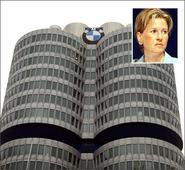
Forbes Magazine has published its list of the world's richest women for the year 2009.

'We actually have a problem because there may be too much activity in India.' 'Markets don't like too much concentration. But we are very happy with our collaborations in India.'

By piling more pressure on governments, central banks risk not accomplishing much and yet provoking a political backlash that could threaten their independence.

'Marginal rates will definitely affect the consumer's decision in entering a new transaction, but in reality, they don't affect much because banks/financial institutions have come up with step-up EMIs: 50% of home loans which exceed 15 years in India are prepaid, within 7-8 years.' 'This doesn't happen anywhere in the world.'

The International Monetary Fund (IMF) on Tuesday said it is expecting some slowdown in the Indian economy next fiscal year and projected the growth to 6.1 per cent from 6.8 per cent during the current fiscal ending March 31. The IMF on Tuesday released the January update of its World Economic Outlook, according to which the global growth is projected to fall from an estimated 3.4 per cent in 2022 to 2.9 per cent in 2023, then rise to 3.1 per cent in 2024. "Our growth projections actually for India are unchanged from our October Outlook.

Professionals with sharp technical skills and knowledge of emerging markets will continue to be in demand, says Nikhil Barshikar, founder and CEO of Imarticus Learning, a tech learning and training company.

Today, with the Lok Sabha polls only months away, any inter-state dispute over the Cauvery water dispute has the potential to take more political turns than otherwise, predicts N Sathiya Moorthy.
